

A Growth Mindset Matters: Helping Youth Be Resilient
The way a child thinks has a big impact on how they see the world. It affects how they handle problems, what they feel when they meet new challenges and how strong they stay when things don’t happen as they wanted. By fostering a growth mindset, youth can approach life with positivity, learn from difficulties, and build the confidence they need to overcome obstacles and embrace new opportunities.
Parents, caregivers and mentors can play an important role in helping young people learn healthy habits to adopt a growth mindset and reach their full potential.
Here’s more information about this mindset, ways parents and caregivers can cultivate one in their child and how Clubs and partners support youth, too!
What Is a Growth Mindset?
A growth mindset, a term introduced by Carol Dweck, Professor of Psychology at Stanford University,1 is the belief that one’s abilities can improve through effort and learning. This mindset views challenges as opportunities for growth and encourages a willingness to experiment and learn.
At Boys & Girls Clubs, staff and mentors help children adopt a growth mindset, building their confidence and helping them see what they can achieve.
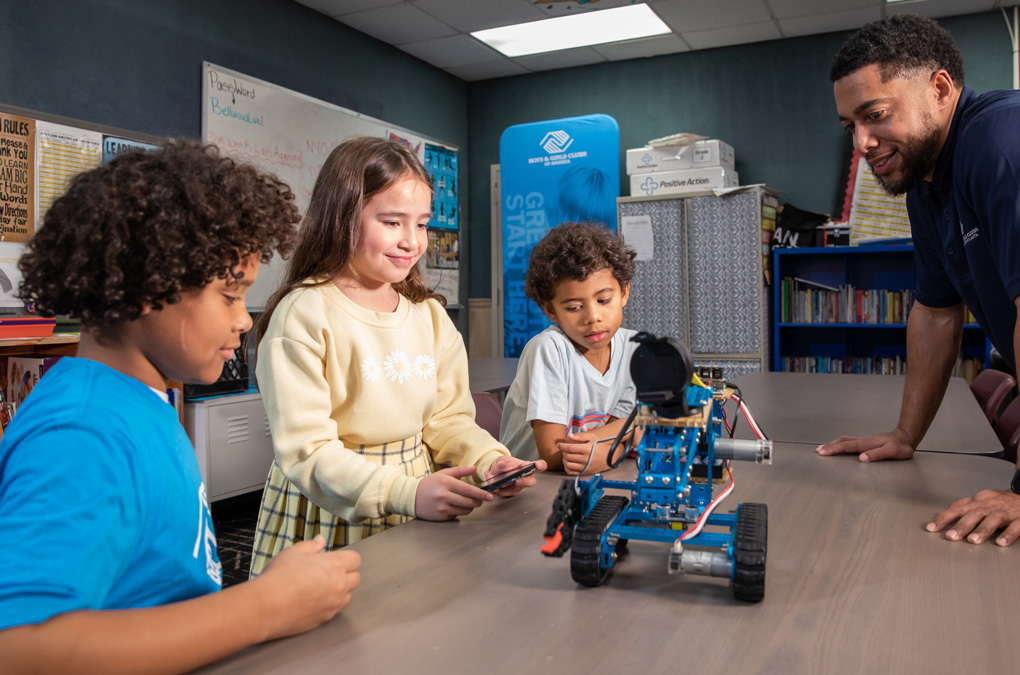
Through partnerships with groups like Caesars Foundation of Caesars Entertainment and Thermo Fisher Scientific, Clubs provide engaging growth mindset activities that teach kids valuable skills through fun and interactive learning.
A Brain Capable of Change
Childhood is a powerful time to encourage a growth mindset, as kids and teens’ brains and bodies are rapidly growing and their behaviors are shaping.
Carol Dweck’s growth mindset theory is illustrated by the scientific concept of “neuroplasticity,” which shows us how adaptable our brains are. What is neuroplasticity? Neuroplasticity is the ability our brains have to be flexible and change. When we learn new things or face challenges, the cells in our brains form new connections. These connections strengthen with more practice and use. This ability shows why we can continually improve our skills if we keep trying and learning.
Neuroplasticity continues throughout our lifetime, meaning people of any age have the ability to be continuous learners and form new behaviors. However, kids’ brains are especially elastic, forming new connections each day. That’s why academic success programs, like DIY STEM in partnership with Thermo Fisher Scientific, are so critical to helping youth develop a growth mindset vs a fixed mindset.
“At Thermo Fisher Scientific, we recognize the importance of fostering a passion for STEM among today’s youth. By inspiring students early in their education journey, we hope to spark their curiosity, build their confidence and develop their resilience and problem-solving skills, all essential to becoming the innovators of tomorrow. Our colleagues are especially committed to engaging with communities that are underrepresented in STEM fields today, nurturing a dynamic and diverse future workforce that can tackle the world’s most complex challenges.” — Meron Mathias, Vice President of Corporate Social Responsibility & Sustainability at Thermo Fisher Scientific
Growth Mindset vs. Fixed Mindset
It’s useful to see how neuroplasticity affects our everyday behavior through the lens of growth and fixed mindsets. A growth mindset uses our brain’s ability to change, pushing us to see hard tasks as chances to learn and grow. On the other hand, a fixed mindset can hold us back, making us think our skills cannot improve, which might stop us from trying new things.
According to Psychology Today, people often find themselves thinking with either a growth mindset or a fixed mindset. It’s important for young people to understand these mindsets to fully understand how they can improve. Are they facing the day with optimism? Are they willing to take on new challenges and believe they will succeed? Or do they feel certain things aren’t worth trying?
Adopting a growth mindset versus a fixed mindset helps kids grow personally and stay open to learning and improving in different aspects of life. Research shows that youth with a growth mindset are more likely to choose activities that challenge them to learn new things.3 When they make mistakes or fail, they view it as a chance to learn and get better, rather than a step backward. This helps them build resiliency and do better in school and life.
At local Clubs, members of Caesars’ community involvement team, known as “HERO,” volunteer time to help kids and teens nurture a growth mindset.
“When our HERO volunteers organize learning activities for local Club kids, like teaching them to rebuild a video game, build a battery-operated torch or prepare delicious treats, the kids take on exciting challenges that help them learn new skills. Although these projects may be difficult at times, kids feel proud and amazed by what they can achieve when they persevere. These experiences inspire Club kids to try something new, which can lead to a future career in that field.” — Marilou Pilman, HERO Chair for Grand Victoria Casino
The Data Backs It Up
Data from Boys & Girls Clubs of America’s 2023 National Youth Outcomes Initiative (NYOI) survey underscores the importance of a growth mindset for kids. Young people who choose activities that challenge them to learn new things are more likely to do well in school and graduate on time.
A growth mindset helps everyone cope with challenges. Rather than seeing challenges as unsurmountable or imagining that their capacity isn’t going to change, people with a growth mindset know that they can become more equipped to solve problems.
And when it comes to Club kids, youth with higher coping skills are also more likely to be on track to graduate on time.
When talking about a growth mindset with your child, remind them that even if they don’t understand something yet, they have enormous potential to keep learning by trying. In fact, developing a learning mindset is something that everyone, at any age, can continue to develop.
How To Support a Growth Mindset Through Growth Mindset Activities
A growth mindset teaches us that the path to success isn’t straight and each bump along the way is an opportunity to learn something new. For instance, when a math problem seems difficult or a child gets an answer wrong, encouraging them to ask: “What can I learn from this?” shifts their perspective from fearing failure to valuing the learning process.
Here are some ways to teach kids a growth mindset:
- Encourage questions and curiosity: Create a safe, judgment-free space for children to ask questions and express their thoughts about what they don’t understand. This openness turns the classroom or home into a learning-friendly environment where mistakes are seen as natural.
- Share stories of successful people who model resilience: Teach children about famous scientists, artists and leaders who didn’t give up despite not succeeding on the first try.. Stories of people like Thomas Edison, who said, “I have not failed. I’ve just found 10,000 ways that won’t work,” illustrate the importance of persistence and learning from errors.
- Focus on effort and progress, not perfection: When discussing a child’s work, highlight the effort and improvement rather than whether the task was completed perfectly. Comments like, “I saw how hard you worked on that,” or “You’re getting better each time!” reinforce the value of trying and improving and build resilience.
- Teach problem-solving skills: Help children develop strategies to tackle problems step by step. When they encounter difficulties, guide them through analyzing what went wrong and brainstorming ways to improve. This process teaches them that setbacks are just problems waiting to be solved.
By cultivating a growth mindset, children learn to navigate the challenges of learning with confidence and curiosity.
Practice Positive Self-Talk
Many of us have heard the age-old saying “You are the company you keep” – but how many of us really think about what this means? And how can we teach this concept to our children?
Grown-ups around them can influence how young people think and handle problems. As parents and caregivers, you have an important role in helping kids build confidence and self-esteem. Show them how to talk kindly to themselves in everyday situations by adopting a learning mindset and modeling it yourself. Even when things don’t go well, remind them that it’s okay and part of life.
For instance, think about a time when you faced something really tough for the first time, like riding a bike or learning to swim. You might have struggled at first, but with practice and effort, you got better and better. This shows that when you work at something, you can improve over time.
Avoid using negative fixed-mindset phrases, like saying, “I’m just not a math person” or “I’ll never be good at running.” Instead, encourage your child to focus on the idea that they might not be good at something “yet,” but with effort and learning, they can get better.
A good practice for positive self-talk is using simple phrases that make your child feel confident and hopeful. Pick ones that fit their age and preferences. Here are some growth-mindset phrases to think about:
- “I can get better when I keep trying.”
- “Challenges help me learn and improve.”
- “I can do great things if I work hard.”
- “I’m always getting better.”
Saying these phrases, again and again, helps them stick in our minds, which can change how we think. Doing something repeatedly is an effective way to change how we look at things. By showing these ideas and using growth-mindset phrases, you can help kids learn to face challenges, see progress and believe they can continually improve over time.
How a Growth Mindset for Students Impacts Their Future Careers
When we focus on improving our mindset, our brain begins to see the power behind taking control of how we interpret our day. The positive self-talk goes from a mantra to a belief, we’re more likely to step out of our comfort zones to try something new, and we feel capable of growth.
Studies show that believing in our ability to learn and improve has a big impact on our success in life.4 As you talk about a growth mindset with your child and incorporate this guidance, encourage them to recognize how this mindset can positively impact their future careers. By cultivating a growth mindset, they will develop essential qualities that employers highly value. The ability to adapt to new challenges, a willingness to learn and grow and a strong sense of resilience are all characteristics that can lead to success in any career.
“Developing a growth mindset is important for young people as they advance in the workplace or at school, work with diverse teams and explore future opportunities because they apply what they’ve learned from those various experiences to the new and exciting challenges ahead.” — Ana Munoz, Director of Community Impact & Giving, Caesars Entertainment
Caesars Foundation, the corporate giving platform of Caesars Entertainment, supports Boys & Girls Clubs of America’s efforts to activate a comprehensive approach to learning through Project Learn. Clubs within select Caesars key markets will benefit from this partnership through a variety of programs and strategies designed to enhance the educational experience of all Club kids. This investment will help Caesars reach its goal of empowering Club kids toward brighter futures by supporting educational programming and connecting with their communities.
The demand for science, technology, engineering and math (STEM) talent continues to grow at a remarkable pace, while access to high-quality STEM education lags behind. Thermo Fisher Scientific and Boys & Girls Clubs of America are changing the game by nurturing a 21st-century STEM workforce that accurately reflects our society and leverages its diversity to solve the world’s most complex problems.
Stay in the Know
Boys & Girls Clubs of America provides youth mentorship, engaging programming and meaningful life experiences that boost youth self-esteem, build confidence and contribute to healthy mental, emotional and physical well-being. Sign up for our newsletter to receive the latest resources and stories from Clubs across the country.
Sources
1 Mindset: The New Psychology of Success by Carol S. Dweck, Ph.D. – http://155.0.32.9:8080/jspui/bitstream/123456789/55/1/Mindset_%20The%20New%20Psychology%20of%20Success.pdf
2 2023 Youth Right Now Report – https://www.bgca.org/about-us/youth-right-now/
3 Mind Your Errors: Evidence for a Neural Mechanism Linking Growth Mind-Set to Adaptive Posterror Adjustments – https://journals.sagepub.com/doi/10.1177/0956797611419520
4 Mind over matter: Study shows mindset is a larger contributor to academic success than socioeconomic background – https://www.fullfabric.com/articles/mind-over-matter-study-shows-mindset-is-a-larger-contributor-to-academic-success-than-socioeconomic-background


